



The Low Shelf: Styling Open Storage Without Clutter
Styling & Space | September 13, 2026
Open shelving is a trap dressed as a design choice. It looks effortless in photographs, and in real life it becomes a surface for mail, keys, charging cables, and the three objects you keep meaning to put away. The problem is rarely the shelf. It is that open storage asks you to decide, item by item, what deserves to be seen. Most of us have never been taught how to make that decision.
The first rule is to treat the shelf as a place for objects you actually use or genuinely love, not for objects that need a home. A shelf full of things that are merely stored is a closet with no doors. If a bowl is there because you eat from it, fine. If it is there because you did not know where else to put it, it will read as clutter no matter how beautiful it is.
Height, Weight, and the Space Between
Good shelves have rhythm. That means varying height and weight rather than lining up similar objects at even intervals. A tall ceramic vase next to a low stack of bowls, a leaning cutting board behind a small brass dish, a single book laid flat under a candle: these small asymmetries give the eye somewhere to rest and somewhere to travel.
Leave more empty space than feels comfortable at first. The negative space is what makes the objects legible. A shelf that is 40 percent empty will look intentional; a shelf that is 90 percent full will look like storage. This is the hardest part for people who collect, because every object feels like it deserves a spot. It does, but not all at once. Rotate. Put half the collection in a box and swap it seasonally. The shelf stays alive, and nothing is lost.
Wood matters here more than people expect. A shelf in solid oak or ash, finished with oil or soap rather than lacquer, gives the objects a warm ground to sit on. Painted shelves can work, but they tend to flatten the arrangement, especially in a neutral room. If you are building shelves, consider leaving the underside and edges visible rather than wrapping them in trim. The joinery is part of the display.
What to Put on a Low Shelf Specifically
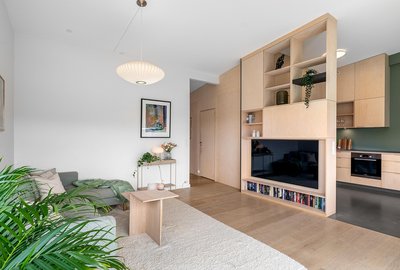
Low shelves, the ones at knee or hip height, are the most useful and the most neglected. They are perfect for things you reach for often: a stack of everyday plates, a wooden tray holding salt and oil, a basket of napkins, a few cookbooks. Because they are below eye level, they can hold more visual weight without overwhelming the room.
Keep the top of a low shelf sparse. One or two objects, nothing more. The eye reads the top edge as a line, and a busy line is distracting. Below that, group by use rather than by category. The things you actually touch every day belong at arm's reach, and the things you look at belong where the light is good. Everything else can go behind a door. That is not a failure of minimalism. It is just good manners toward your own attention.


-

-

-
The Grain You Can Feel: Choosing Wood Species for a Warm Minimalist Home
Sep 9, 2026Color & Palette


Ochre and Oak

Why the ceiling light is usually the enemy of a calm room, and how layered low light changes the way a space feels after dark.